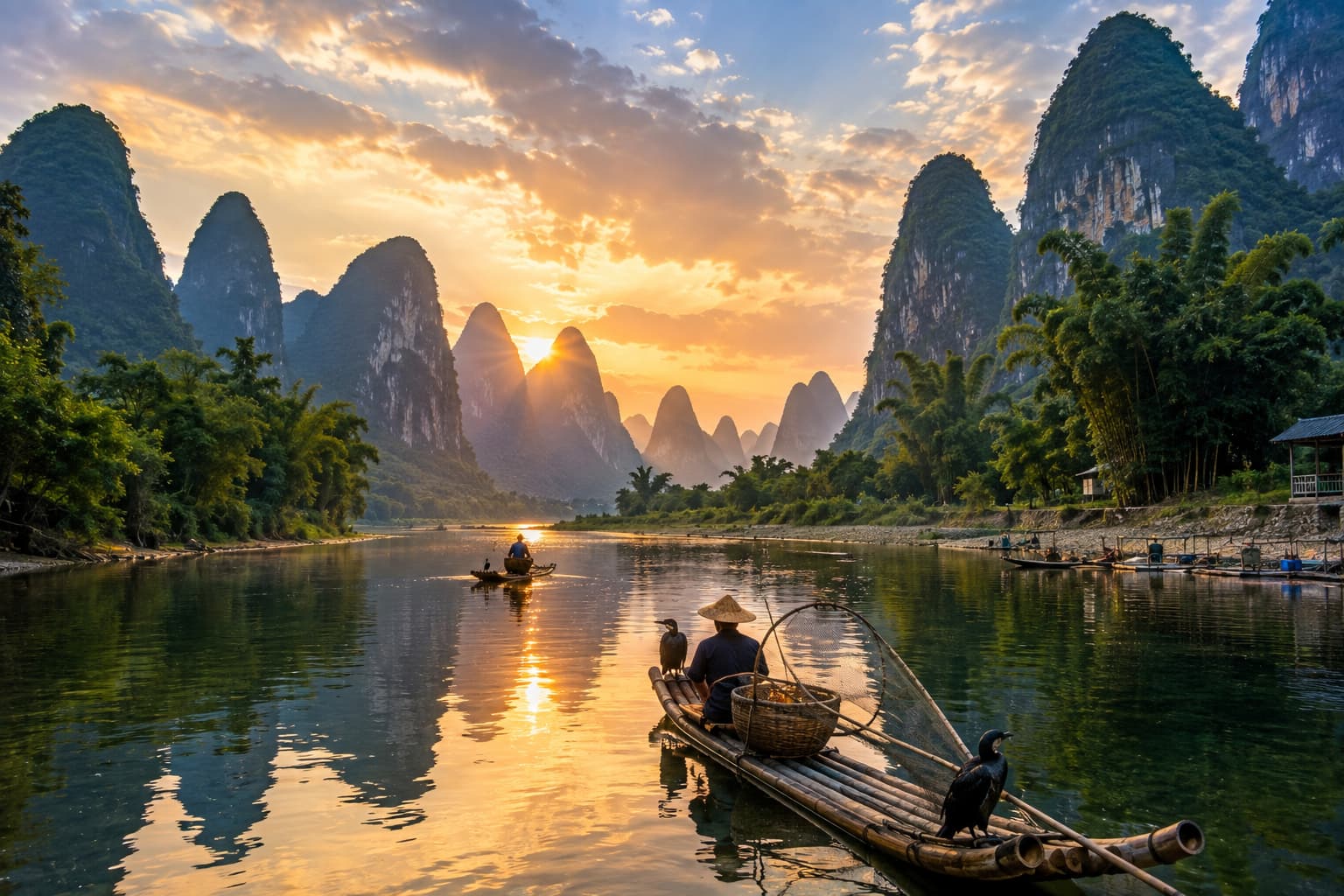
Designers spend their days chasing perfect composition: balance, harmony, and the elegant use of empty space. The Li River in southern China is where nature does it better than any of us ever will.
Drift down this emerald ribbon of water through a forest of misty limestone peaks, and you are looking at what may be the most perfectly composed landscape on Earth, all layered silhouettes, mirror-still reflections, and effortless breathing room. It is a scene so flawless that China printed it on the back of the 20 yuan note. For anyone who works in visual design, it is also a living lesson in negative space and restraint, the very principles good work is built on, and the kind of view that stirs the same awe and calm that emotion designers spend whole careers trying to engineer.
How you experience it depends on how close to the water you want to get, from a comfortable cruise deck to a raft that sits right on the surface.
A few things make a trip go smoothly. The classic cruise runs one way, downstream from Guilin to Yangshuo, so plan around that. Book reputable operators, bring your passport for pier check-in, and time your visit for clear or misty weather rather than rain. Here are the best ways to experience it, ranked.
1. Compare and Book It All in One Place
The Li River offers full cruises, shorter bamboo rafts, and hikes, with different boats, piers, routes, and prices, plus surrounding sights in Guilin and Yangshuo. Sorting that from home, especially the downstream-only logistics, is genuinely confusing. Li River Cruises is a platform built around this journey, so instead of guessing you get the options laid out clearly by experience, boat class, and what each includes.
The value is that it matches the trip to your style and handles the details that trip people up, from pier transfers and passport check-in to choosing between a 3-star and 4-star cruise. You can weigh a relaxed cruise against an up-close raft, and book a reputable operator rather than risking a sold-out high-season date.
You can compare Li River cruises here and sort the logistics before you go, which matters given the one-way route.
Best for anyone who wants a smooth trip without the guesswork. If you already know your plan, book directly.
2. The Classic Cruise: Guilin to Yangshuo
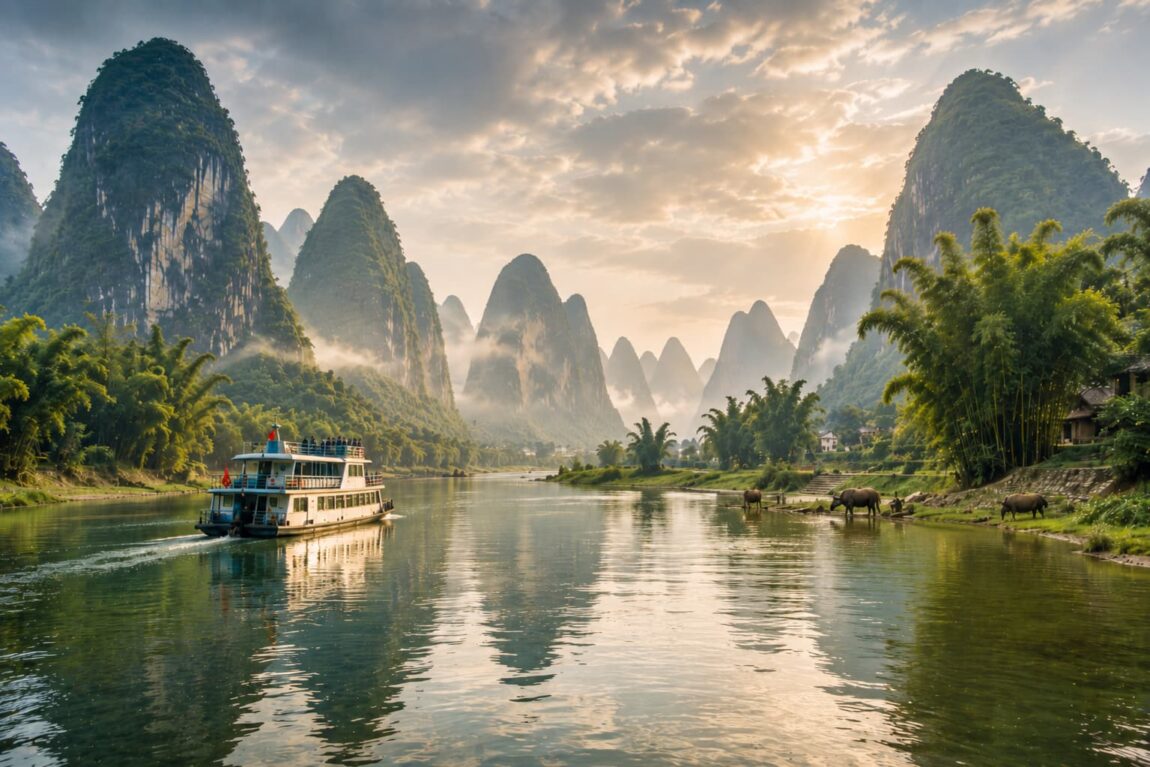
This is the definitive way to see the river. The cruise departs from a pier south of Guilin and glides roughly 83 kilometres downstream to Yangshuo over about four hours, unspooling the finest stretch of karst scenery the whole way. You pass whimsically shaped peaks, bamboo groves, water buffalo in the shallows, farmers working the banks, and, of course, the famous 20 yuan note view near Xingping.
The comfortable boats have an enclosed lower deck, an open top deck for photos, and a buffet lunch on board, making this the relaxed, effortless choice for most visitors. It genuinely feels like sailing through a traditional ink-wash painting.
For the best light on the karst towers, aim for a seat on the left side, and remember it is one way only, with no return cruise back to Guilin.
Best for first-timers and anyone who wants the full, comfortable Li River experience.
3. Up Close: The Bamboo Raft at Xingping
For a more intimate encounter, take a bamboo raft along the Yangdi-to-Xingping stretch, the most scenic section of all. Sitting low on these four-seat rafts, you are right down at water level as you pass Nine-Horse Fresco Hill and the exact scene from the banknote, a roughly 1 to 1.5 hour journey that feels far closer to the river than a big cruise ship does.
It is cheaper, shorter, and perfect if you are already in Yangshuo or want to skip the full cruise while still catching the iconic views. Dawn and dusk bring the calmest water and softest light.
Modern rafts are motorized and can be a little noisy, and you may share with other passengers unless you pay for a private one, so it trades some tranquillity for that closeness.
Best for photographers and travelers who want to feel the river up close.
4. Yangshuo and the Countryside
The cruise ends in Yangshuo, and this laid-back town is a destination in its own right. Wander the lively West Street, cycle through emerald rice paddies along the gentle Yulong River, explore the Ming and Qing lanes of Xingping Ancient Town, and watch traditional cormorant fishing at dusk. In the evening, Zhang Yimou’s spectacular Impression Sanjie Liu light show stages hundreds of performers on the river itself, with the floodlit karst peaks as a backdrop.
This is where the region really gets under your skin, and plenty of travelers who booked two nights end up staying five. Yangshuo is also one of Asia’s best-known rock-climbing hubs.
It can get busy and touristy in the town center, so venture into the surrounding countryside for the real magic.
Best for travelers who want to slow down and soak up rural Guangxi.
5. Beyond the River: Guilin and the Longji Rice Terraces
To round out the trip, look beyond the river itself. Guilin, the gateway city, has its own charms in Elephant Trunk Hill and the illuminated Reed Flute Cave. And around 100 kilometres north lie the breathtaking Longji Rice Terraces, where centuries of farming have sculpted entire mountainsides into shimmering, contour-hugging steps, a masterpiece of human design working with the land.
Pairing the flowing lines of the river with the geometric terraces gives you the full sweep of this extraordinary landscape.
The terraces are a bit of a journey, so while a day trip is doable, an overnight lets you catch them at sunrise and sunset.
Best for travelers with extra time who want the region’s full range of scenery.
A Few Practical Things Before You Go
Plan around the one-way route. The classic cruise only runs downstream from Guilin to Yangshuo, so build your itinerary accordingly, and carry your passport for pier check-in. Book ahead in high season, and decide early between the comfortable cruise and the up-close raft.
Time it well. April to early November is the sweet spot, when the karst is lush and green. Spring often brings an atmospheric mist that makes the peaks look painted, autumn delivers the clearest skies, and midsummer is lush but hot, humid, and prone to rain. Try to avoid the Chinese national holidays, when crowds peak. Guilin is the gateway, reachable by a short flight or bullet train from major Chinese cities.
And here is a thought for the design-minded: we obsess over the perfect visual experience on screen, right down to the rise of dark mode, but some views are best enjoyed with the phone tucked away. For background, UNESCO’s South China Karst listing covers the geology, and Lonely Planet helps with planning. Both pair well with any related travel guides already on the site.
Choosing the Right One for You
The Li River rewards travelers who match the experience to how close they want to get.
Start by comparing your options through Li River Cruises so you sort the boats and the logistics. Want the full, relaxed journey, take the classic cruise to Yangshuo. Craving intimacy and photos, ride a bamboo raft at Xingping. Wanting to linger, base yourself in Yangshuo and explore the countryside. Hungry for more, add Guilin and the Longji terraces.
However you do it, put the camera down for a while and simply look. This is composition on a scale and with a serenity no screen can hold, a masterpiece painted in stone, water, and mist over millions of years. Few landscapes are worth crossing the world for. This one absolutely is.
Author note: recommendations here reflect the Li River’s cruises and logistics as of 2026. Prices, boat classes, and seasonal conditions change, so confirm the current details and book ahead before you go.